Play Go Online
Start with One Stone
You do not need a book of opening rules before your first game. Choose a 9x9 board, place the first black stone, and see what the position asks for next. Short games make it easy to try a new idea straight away.
What are you trying to do in Go?
Players take turns placing black and white stones on intersections. Stones do not move after they are placed. A connected group is captured when it has no empty adjacent intersections, called liberties.
Captures are only part of the game. You are also keeping your own groups safe while surrounding more territory than your opponent.
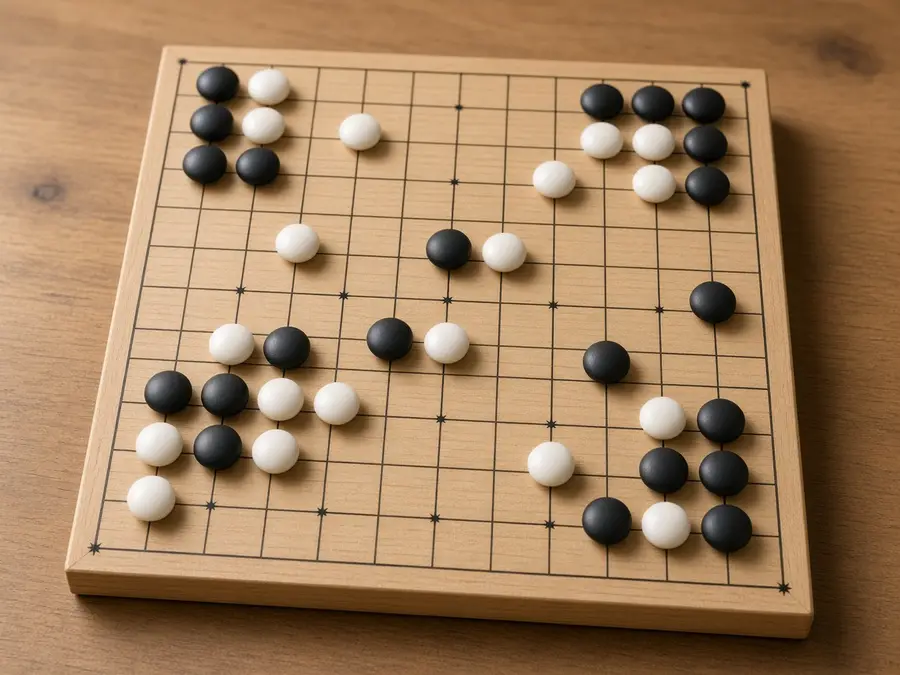
Practice quietly or test yourself
Begin with a gentler AI opponent, then increase the challenge when you are ready. Restart, undo, or ask for a hint while you learn; one bad move does not have to end the experiment.

Why start on a 9x9 board?
A 9x9 board has 81 intersections, so contact, captures, and scoring arrive quickly. The rules are identical to larger boards; the results are simply easier to see.
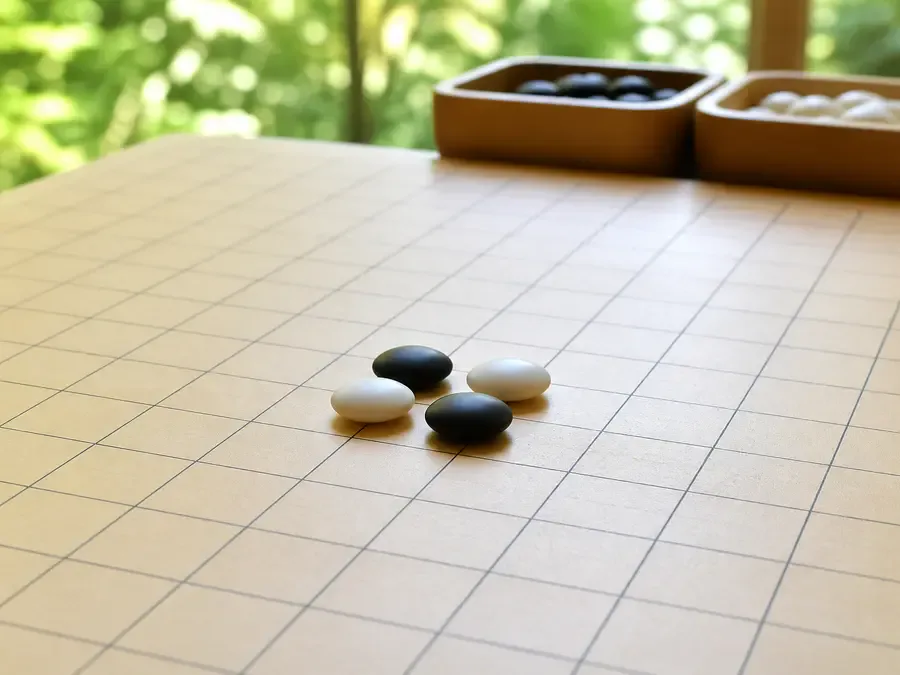
Play alone, together, or from apart
Practice against AI, take turns on one shared device, or open a room and send its link to a friend. Every mode supports 9x9, 13x13, and 19x19 boards.
9 · 13 · 19board sizes
Local AIpractice at your pace
2 playersone shared device
Roomsplay online
Common questions
Which rules does this board use, and what is the komi?
The default is Chinese rules: area scoring, with 7.5 komi for White. You can switch to Japanese or Korean rules, which both use territory scoring and 6.5 komi for White. Placing and capturing stones work the same way; the difference is how the finished game is counted. Boards are 9×9, 13×13, or 19×19.
How is this AI different from a typical web Go opponent?
This site uses the open-source KataGo engine and its neural network, reading later variations in the browser while the sidebar shows visits, search speed, the point lead, and the main line together. A lot of web Go only searches a little way ahead, or waits for a server to return the move; here you can watch the thinking itself.
Why did a whole group disappear when the board was full of my stones?
Having more stones on the board is not the same as being ahead. A group lives only when it has at least two separate eyes. If one liberty is left, the opponent can fill it and capture the entire group. Those empty eyes are your territory, so do not fill them in one by one.
Does the first move have to be on a star point or tengen?
No. This board does not require the opening stone on a particular intersection. On 9×9, it is more useful to see liberties, eyes, and whether a group can live than to claim one fixed point.
How should I use hints, undo, and replay without just copying the answer?
Choose a point yourself first, and say whether it makes an eye, surrounds territory, or answers the opponent's liberties. Then open the hint and compare. The hint follows your current AI level; it is not a stronger engine hiding behind the button. Undo returns you to the fork so you can try another idea. Replay is for finding the move where territory or liberties turned, not only for watching the last capture.